03 / O-HIVE
The capture is only
the beginning.
A digital twin is valuable when a team can use it to make a decision. I led the product work connecting captured environments, review, issue ownership and reporting.
The opportunity
Move beyond the impressive capture.
Spatial capture and AI analysis could reveal far more than an ordinary inspection photograph. But the technical demonstration did not yet answer a site team’s practical questions: what needs attention, who is responsible and whether the finding has been resolved.
I focused the product on a complete review loop. The first release needed to connect evidence to action reliably before expanding into a broad set of analytical features.
A product people could work in
One finding. A complete path to resolution.
I defined the shared model across the viewer, discussion, task assignment and reporting. A finding kept its location, captured context, conversation and owner as it moved through the workflow.
That decision made the review process more coherent for customers and gave engineering a consistent set of objects and states to build around. The interface could change between desktop and mobile without changing the underlying responsibility.
Clearance at service riser
A captured view, a precise location and the context a reviewer needs.
Follow a finding through the review.
Product and engineering
Keep the difficult decisions close to the build.
I translated customer workflows into requirements and prioritised them with the distributed engineering and AI teams. We worked through permissions, review states, uncertain detections and what belonged in a report, alongside how the experience should work.
I treated AI detections as reviewable proposals. A person remained responsible for accepting the finding and deciding the next action. That kept the product useful where the consequences of a mistaken classification mattered.
A bounded first release
Prioritise the complete review loop over a larger catalogue of disconnected technical capabilities.
Human accountability
Keep machine detections distinguishable from accepted findings and preserve the reviewer’s decision.
Delivery across teams
Use shared acceptance criteria and a visible release sequence to coordinate spatial, AI and application work.
From the office to the site
The workflow had to travel with the work.
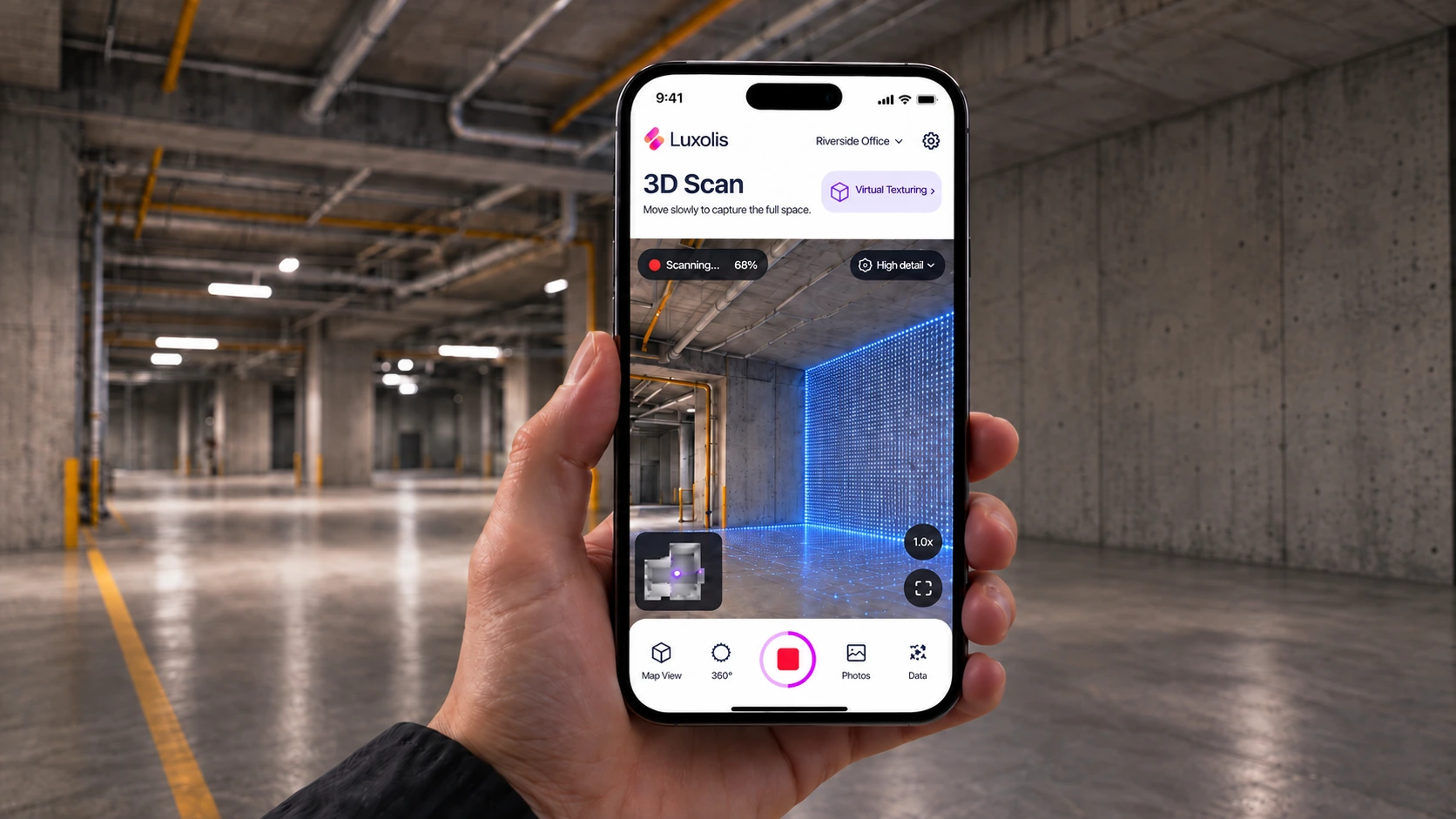
A review could begin at a desktop and continue with someone checking a physical location. I made project files, issue context and task status part of the same product model, rather than treating mobile as a smaller version of the main viewer.
The reporting view brought accepted findings and outstanding actions together. Review output could become an operational handover instead of another collection of screenshots.
Continuity across devices
Keep the context.
Change the surface.
A finding should remain understandable when it passes from the person reviewing the model to the person responsible for the work.
What changed
A review product,
not just a technical viewer.
The product reached public launch with a connected review workflow. The broader direction gave the team a clear basis for enterprise pilots: demonstrate how a captured finding becomes an assigned and reportable action.
- A shared model for findings, conversations and ownership.
- A practical release sequence across application, spatial and AI teams.
- A product story centred on operational decisions.